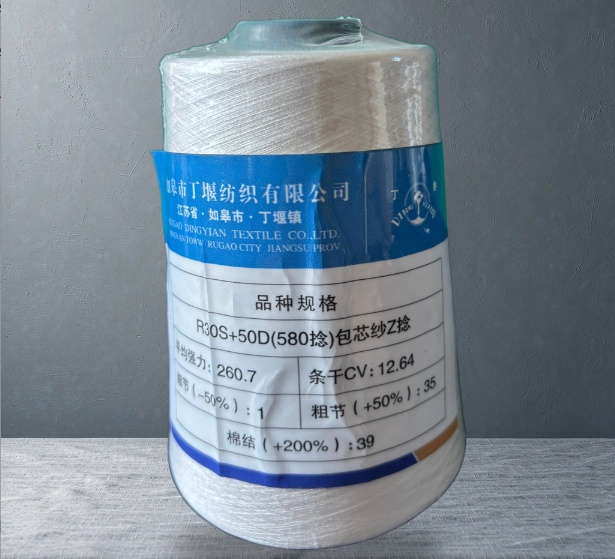
Product Specifications
| Item | Specification |
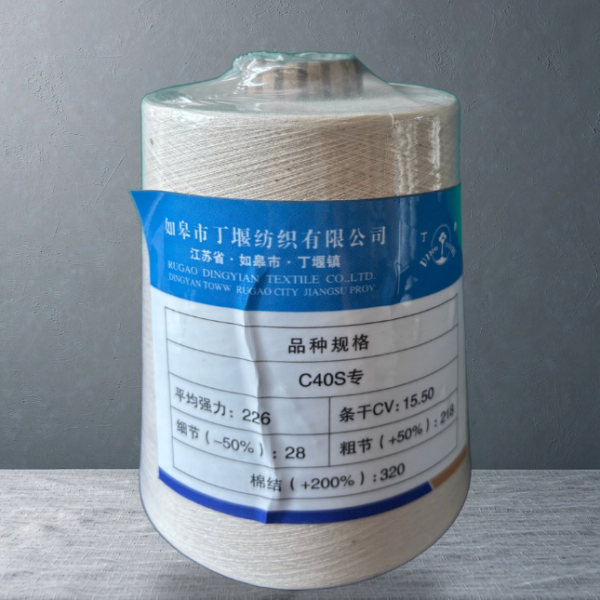
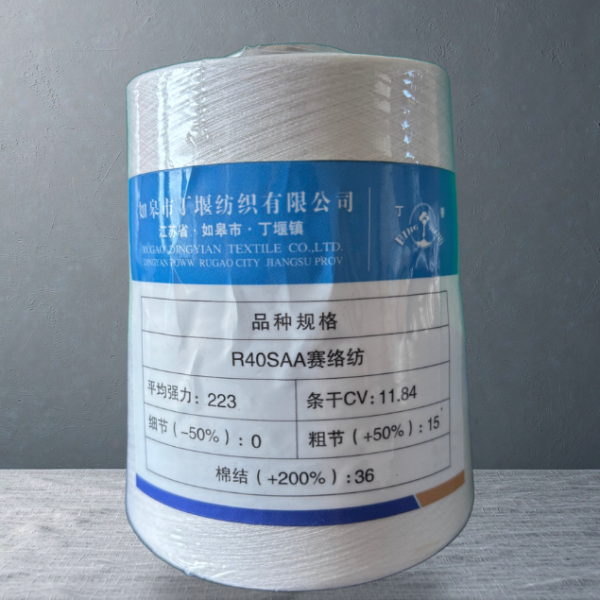
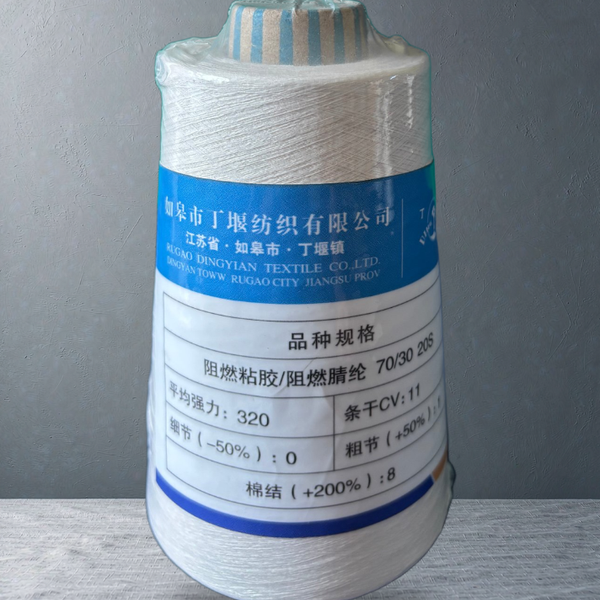
| Manufacturer | Rugao Dingyan Textile Co., Ltd. |
| Brand / Series | DING XIANG |
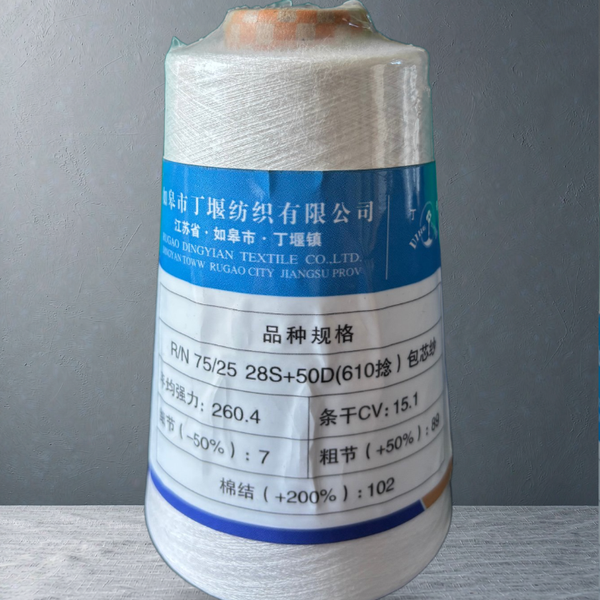
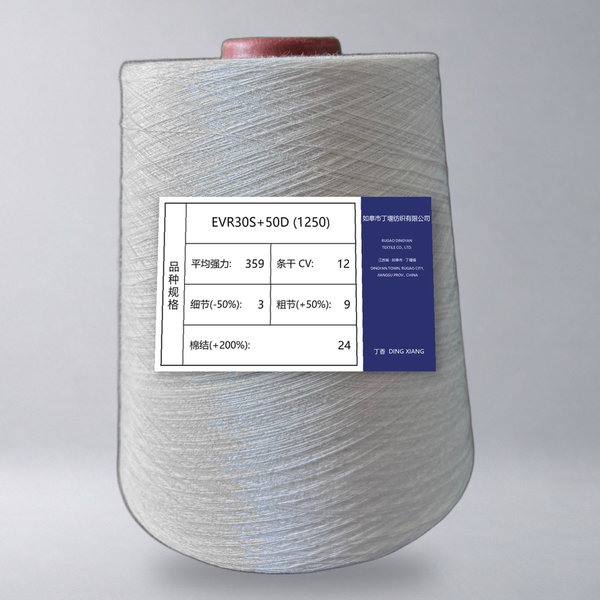
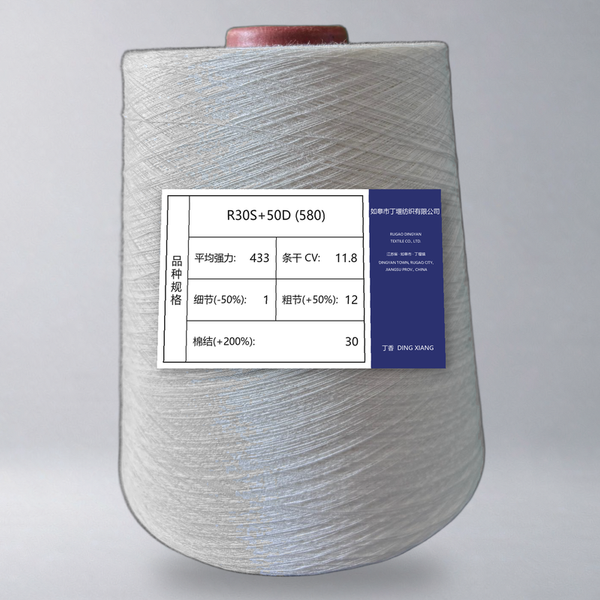
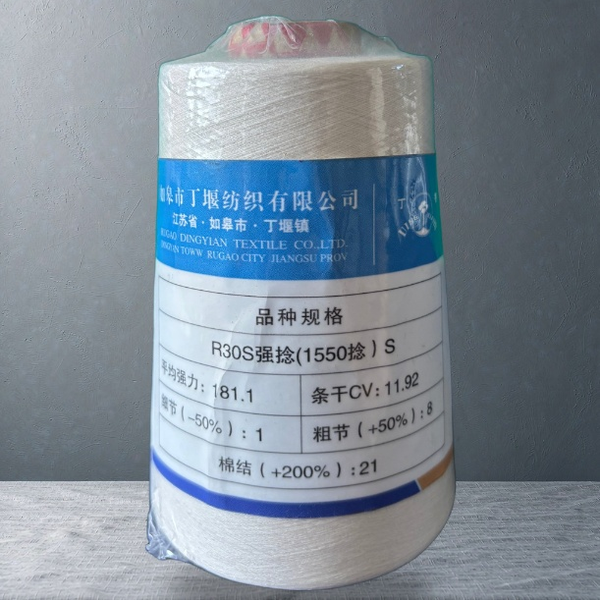
| Product Code | Viscose Ne 30s + 50D core-spun, 580 TPM Z |
| Construction | Filament core, viscose fibre wrap |
| Core Yarn | 50D filament (core type stated per order) |
| Fibre Composition | Viscose wrap with filament core |
| Yarn Count | Ne 30s (English cotton count) |
| Twist Level | 580 TPM |
| Twist Direction | Z-twist |
| Average Breaking Strength | 260.7 cN (single-end) |
| Yarn Evenness | CV 12.64% |
| Thin Places (−50%) | 1 per 1,000 m |
| Thick Places (+50%) | 35 per 1,000 m |
| Neps (+200%) | 39 per 1,000 m |
| Also Available In | S-twist and higher twist levels to order |
| Factory Address | No. 206 Dingxin Road, Rugao City, Nantong, Jiangsu Province, China |
Product Introduction
A filament core inside a staple wrap changes what the yarn can do. The surface behaves like viscose — it absorbs dyestuff, feels natural and can be brushed or raised — but the load-bearing core behaves like filament, giving a strength of 260.7 cN and elongation characteristics closer to a synthetic yarn than to spun viscose.
Z-twist is standard here and should be specified explicitly if you are building a fabric from several yarns, because matching twist direction between warp and weft is what determines whether the finished structure is tight and compact or open and soft.
Key Advantages
Filament core raises elongation control. Unlike a pure spun yarn, the core limits how much the yarn stretches under tension during weaving. This stabilises warp tension and gives more consistent pick spacing, which can be seen as reduced weft barre after dyeing.
260.7 cN permits core use in warp. The strength figure is high enough for normal warping without the sizing reinforcement that pure viscose warp requires. For mills without a dedicated viscose warping line, that removes a processing constraint.
Staple surface for standard dyeing. Because the wrap is viscose, the yarn dyes with reactive and direct dyestuffs on a normal cellulosic route, unlike filament polyester or nylon yarns that need disperse dyes and high-temperature equipment.
Evenness CV 12.64% for a composite yarn. Composite structures normally drift above 13% evenness; this one stays below, giving a fabric surface acceptable for medium-depth piece-dyed shades.
Recommended Applications
Everyday woven & knitted apparel — Denim and trouser fabrics requiring strength, casual shirting, shaped vests and knitwear needing dimensional stability.
Home textiles — Bedding and upholstery fabrics where strength is required without giving up a cellulosic dye route and natural surface.
Ordering & Service
| Item | Detail |
| Customisation | Blend ratio, yarn count and twist level adjusted to order |
| Sampling | Available on request — please state the count and quantity required |
| MOQ | Please state your required quantity when enquiring |
| Lead Time | Quoted per order against quantity and specification |
| Trade Terms | To be agreed (EXW / FOB) |
| Contact | jiuzhuojin@gmail.com |
| Production Base | 80,000 ring spindles · 150 air-jet looms |