Product Specifications
| Item | Specification |
| Manufacturer | Rugao Dingyan Textile Co., Ltd. |
| Brand / Series | DING XIANG |
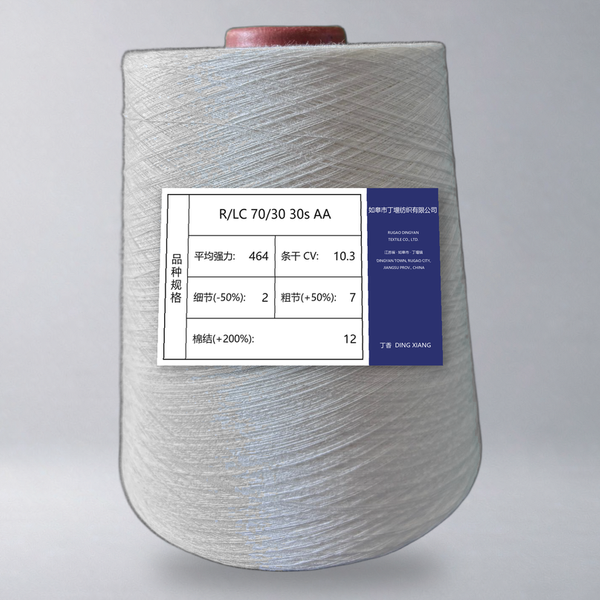
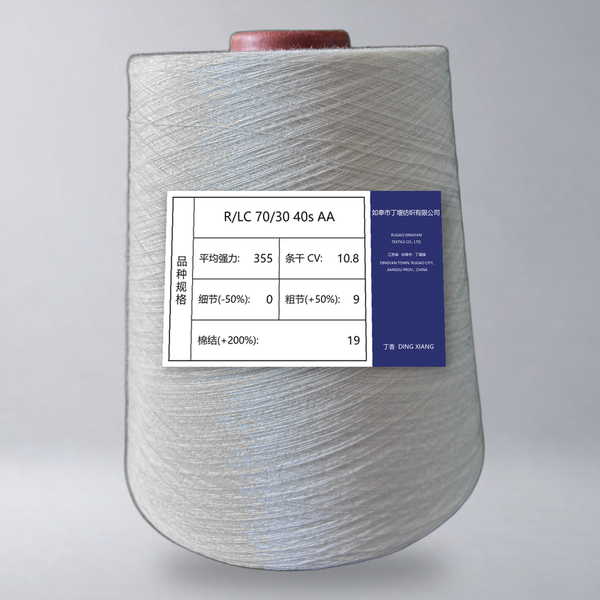
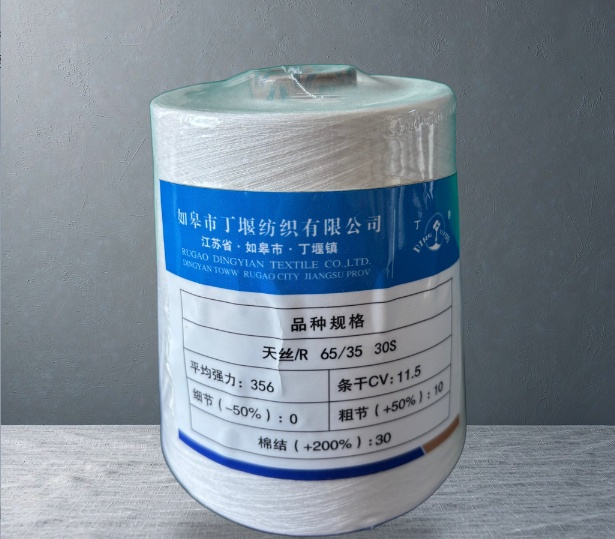
| Product Code | Lyocell / Viscose 65/35 Ne 30s |
| Fibre Composition | 65% Lyocell, 35% Viscose |
| Yarn Count | Ne 30s (English cotton count) |
| Spinning Method | Ring-spun, intimate blend |
| Average Breaking Strength | 356 cN (single-end) |
| Yarn Evenness | CV 11.5% |
| Thin Places (−50%) | 0 per 1,000 m |
| Thick Places (+50%) | 10 per 1,000 m |
| Neps (+200%) | 30 per 1,000 m |
| Also Available In | 100% lyocell Ne 30s where maximum lustre is required |
| Factory Address | No. 206 Dingxin Road, Rugao City, Nantong, Jiangsu Province, China |
Product Introduction
Blending 65% lyocell with 35% viscose is a cost decision rather than a compromise on handle: at this ratio the lustre and cool hand of lyocell are carried by the majority fibre, while the viscose component pulls the yarn price down and improves dyestuff affinity. At Ne 30s the blend also gains stability — 356 cN single-end strength with zero thin places per 1,000 m.
Both fibres are cellulosic and dye with the same dyestuff classes, so the blend accepts standard reactive recipes without the two-colour problems that arise when a cellulosic fibre is blended with polyester or acrylic.
Key Advantages
Zero thin places per 1,000 m despite the blend. Intimately blending two cellulosic fibres usually costs regularity, because the fibres differ in length and friction. Holding thin places at zero means the blend can be warped directly, without the strengthened warp preparation that a mixed fibre yarn normally demands.
356 cN carried by the lyocell component. Strength in this blend comes predominantly from the lyocell fraction, since lyocell fibre has roughly twice the tensile strength of standard viscose. The practical benefit is a mid-weight yarn that survives both weaving tension and wet finishing.
Better dye uniformity than 100% lyocell. Viscose has faster dyestuff uptake than lyocell; blending them makes the yarn more receptive to dyestuff overall and reduces the dyeing time and electrolyte load compared with pure lyocell.
Cost positioning for volume programmes. For programmes where the fabric will be sold on handle rather than on a fibre brand, this blend delivers the relevant part of lyocell performance at a materially lower yarn cost, which usually matters more than the last few percent of lustre.
Recommended Applications
Mid-weight apparel — Autumn-weight shirting, shirt-dresses, lightweight jackets, quality trouserings and cardigan knits.
Home textiles — Bedding sets, loungewear and decorative soft-furnishing fabrics where drape and softness outweigh maximum surface lustre.
Ordering & Service
| Item | Detail |
| Customisation | Blend ratio, yarn count and twist level adjusted to order |
| Sampling | Available on request — please state the count and quantity required |
| MOQ | Please state your required quantity when enquiring |
| Lead Time | Quoted per order against quantity and specification |
| Trade Terms | To be agreed (EXW / FOB) |
| Contact | jiuzhuojin@gmail.com |
| Production Base | 80,000 ring spindles · 150 air-jet looms |